"There is a truth to sport, a purity, a drama, an intensity. A spirit that makes it irresistable to take part in, and irresistable to watch. In every Olympic sport there is all that matters in life.

And one day we will tell our children, and our grandchildren, than when our time came we did it right."
- Seb Coe, opening the 2012 games
Showing posts with label ExCel. Show all posts

Wednesday, 8 August 2012

Wrestling, Greco-Roman style

"Mrs Simpson, this is the most blatant case of false advertising since my suit against the movie The Neverending Story"

Greco-Roman Wrestling is not Greek.  Or Roman.  It was actually invented by the French, who presumably thought that French Wrestling sounded too much like a Blackadder punchline to be a credible sport.  It differs from its freestyle counterpart in that all the holds must be above the waist.  You win points by chucking your opponent out of the ring, pinning their shoulders to the ground, or by escaping this situation:

'Oh - THAT's where the Greek part comes from...'

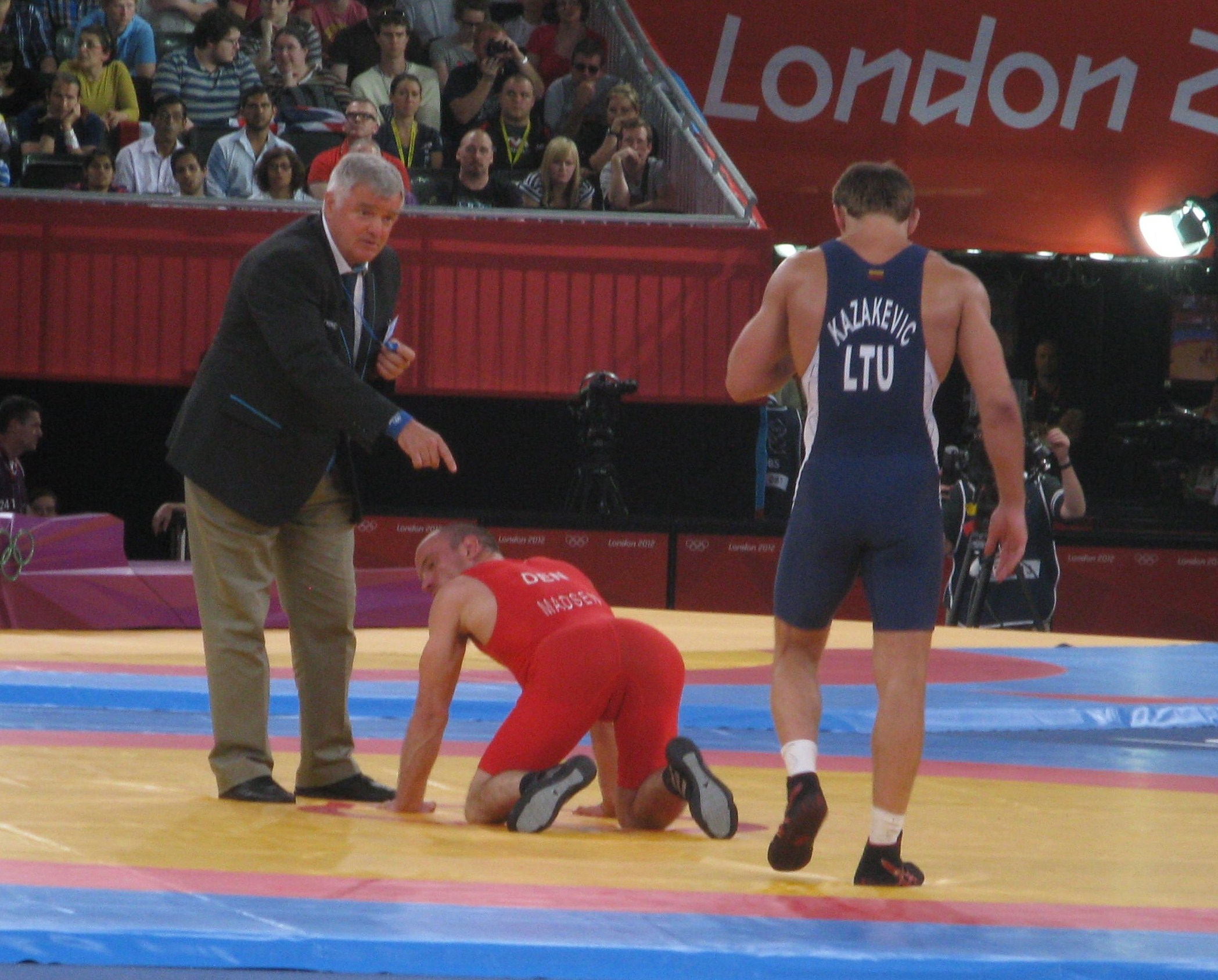
The wrestling arena is a real bear pit.  Hardcore groups of supporters from places like Georgia and Armenia cluster around massive flags and get some serious vocal support generated.  The Iranians are out in force too, and having won two gold medals in two days here, they are all here to see their man make it a hat-trick in the final of the under 96kg competition.  The towel used to mop the men between rounds is then flicked to dry them, producing billowing clouds of sweat.  It's macho, very loud, and, oh, 'I kissed a girl' is on the PA system.  Perhaps this is to enrage the competitors.  


These are men built like brick walls, and fight like brick walls would fight if there were an Olympic medal at stake.  A Georgian showboats momentarily on his way to a bronze medal, but that's the only moment of anything less than complete respect for the competition.  It's an awesome sight to see men literally fighting for medals - even the winners emerge bruised, patched-up, exhausted.  For those who can't claim the final victory there's nothing but complete exhaustion.  An Armenian bronze medalist, even in victory, is too tired to celebrate.  When a Korean and Hungarian face off in the final of a lighter weight class, the Korean throws his opponent for a victory and suddenly finds the reserves to jump around the arena.  


The last fight of the day is a heavyweight clash between Iran and Russia.  As the giant Iranian triumphs, his coach jumps onto the stage and celebrates by flinging his man over his head onto the mat.  We've come a long way from the beach volleyball.

Sunday, 5 August 2012

Anyone for (Table) Tennis?

Last night was always going to be a hard one to follow.  Headed to ExCel for a team quarter final in the sport which Boris Johnson memorably announced to the world was invented by the British under the name of Whiff Waff.

The men's team competition has the national teams playing out a doubles match and a maximum of four singles ties.  Players enter the arena to a showbiz sound and light show which reminds me of a darts competition.  I wonder whether an enterprising publicist could make a big-time spectacle of the game created on the dining tables of Victorian England?  It could hardly be a stranger hit than darts, which pulled the same trick with some intro music and a few well-placed nicknames.  The umpire signals which player has won a point with some kind of clenched fist salute, which is... odd.

Game, Venezuela.  ALL the games, Venezuela.

The unquestioned powerhouse of the sport is China, who claimed gold and silver in both individual competitions, but this afternoon's crowd favourites are Germany.  They line up against an Austria team who fold like cheap lederhosen on the table nearest us.  At the far end of the arena is a fascinating clash between Portugal and South Korea - who came through a politically delicate clash with North Korea in the first round.  No Portuguese player is ranked inside the world's top thirty while four Koreans are in that club, so they start as strong favourites.


Top level table tennis is played with an extreme range of styles.  Some players rely on paddle speed and accuracy, others exert a whole range of vicious spins on the ball.  At one point a ball lands on the floor and, instead of bouncing, rolls in an arc around a table leg.  There are some players who crowd the table, others like the Korean Joo Saehyuk make an art out of defensive play, throwing themselves around the arena and giving themselves time to reach every ball, forcing their opponent to make mistakes.

Saehyuk takes on crowd favourite Marcos Freitas, who stands firm at the table and smashes the ball about for Saehyuk to chase. It makes for a dynamic contest.  Later, with the scores level at 2-2, Freitas is set to take on the Korean number one for a place in the semi finals.  Sneak downstairs to get a totally different view - from behind the players you can see just how much the ball moves in the air.  Favouring the underdogs, we manage to get the whole crowd chanting 'Marcos, Marcos', and he goes on a run of six straight points.  Result.  Sadly that's as good as it gets, and the Portuguese are out.  Korea will meet Hong Kong for a place in Wednesday's final, while the Germans will face a massive task against China.


Thursday, 2 August 2012

Boxing: Reds or Tails

Right.  Day five.  I've been watching sport continuously for about a hundred and thirty hours now.  Things are getting a tiny bit fuzzy around the edges.  What I need is a sport whose rules I already know.  Boxing.  Perfect.  And we're in the arena, the seats are pretty good, and Steve Bunce (British voice of boxing and Legend of Radio Five Live's Fighting Talk) is sitting at the press benches.  And he's really friendly!  This is starting so well!

Madeley.  Bunce.  King.  One day this will be a Fighting Talk line up.

Then boxing happens.  For those of you who've never known boxing in any form other than the bloated, showbiz behemoth that happens in Las Vegas casinos during the middle of the night, the Olympics is something else.  An amateur competition, the object is to land as many punches as possible, rather than one or two well-timed super blows.  The first bouts are at Bantamweight, one of the lightest weight classes.  Fighters must weigh in under 56kg, or about 8 3/4 stone.  This makes for incredibly fast-paced action, sharing more in common with the fencing I saw yesterday than a heavyweight slugfest.

In the first fight, the Cuban fighter Alvarez Estrada, in the red corner, takes on an American opponent fighting in blue.  We're into the political allegory already.  From James Jeffries, the 'Great White Hope' of the turn of the last century, through the fights between the black American Joe Louis and Hitler's German champion Max Schmelling in the 1930s, to  Rocky IV, boxing has often come to mirror politics - or perhaps the other way around.  The Cuban triumphs this time, despite two of the judges giving each of the three rounds to the American.


Amateur boxing is scored by five judges, spread evenly around the ring.  They push a red or blue button on their desks each time they see a legal punch land, and if three push the same colour at once, a point is awarded.  I'm amazed that judges watching the same fight can score the second round 6-3 to America and 8-5 to Cuba respectively, but the small men have fists flying at such speeds that line of sight can totally alter your perception of the contest.  The American, Joseph Diaz Jr, hits harder, but reigning World Champion Estrada throws more shots, and that's the key to victory in this format.

The six bantamweights who follow lack the class of Estrada, but have their strengths too.  Brazilian Viera dances a latin beat into the ring, and beats a stiff Russian with flair.  Irishman John Joe Nevin is a master at jumping out of the way, leaving his Khazakh opponent flailing like a man trying to punch a ghost.  A 21 year old Mexican, Fierro, has fists which flash out and back into his body again like a chameleon catching flies.  All are victorious out of the red corner.


Now we see some heavyweights.  The difference is startling, like slowing down onto local roads after a long drive at motorway speeds.  There's more power here, too.  And we're back to the politics - it's USA vs Russia!  Rocky Balboa vs Ivan Drago!  Some names may have been changed to protect those born before 1990.  The fight of the afternoon so far finishes in a 10-10 tie, with the Russian emerging the victor having had a fractionally better final round.  He's been in red, too, which is starting to look like it might help.

Another bout goes to the red corner.  Contest number seven is between the world number 4, in blue, and an Argentine who lost in the first round of his only World Championships.  This streak ends here, right?  The unheralded South American crushes his opponent, 13-5.  I'm starting to wonder about probability theory.

The Super-Heavyweights enter the ring, men with no upper limit on weight at all.  They all seem to have names like mechanical dinosaurs from some oddball Japanese cartoon - Magomedrasul and Megomed.  They are vast, and when they land punches the damage is more than a simple point.  The big variations in the judges' scores are gone now - a solid punch is powerfully obvious to everyone in the arena.  A Congolese fighter has his fight stopped to prevent him taking further punishment; he gets the biggest cheer of the day for his bravery in defeat.


Another Russian beats another American.  The reds keep on winning.  The sense of a political metaphor is growing unbearable.  Ten fights have come and gone, ten fighters in the red corner have emerged victorious.  I make that streak about 500-1 odds.  An Italian comes out in blue and wins the last fight of the evening in superb style.  The dream of a redwash is over.

This Italian is Roberto Cammarrelle, the defending champion.  This is itself is a rarity.  After Olympic gold, the vast majority of these amateur fighters in high demand are drawn into the professional game by high profile and huge financial incentive.  For a European boxer to resist these and remain amateur for another Olympiad is rare.  I make a mental note to support anyone who's back to defend a title.

The spectator experience, as I found in the Excel centre yesterday during the fencing, wasn't up to the best venues of the Olympics.  The roof is low, so grandstands are on a shallow gradient, keeping you well back from the action and hoping not to have anyone tall sit in front of you.  Surely boxing deserved more than this. I'm surprised it couldn't have filled a much better spectator venue like Earls Court.  I'm back there next week for table tennis and taekwondo, so will hope it's not the case throughout the centre.

Tuesday, 31 July 2012

On The Fence

Found a great piece by Bill Simmons on the experience of watching a top level sporting event with little to no clue what's going on (he's another handball convert too, by the way... the gospel is spreading!), and I'm getting the same experience at the Excel centre. Fencing is lightening-fast, decided by inches, and, in this instance, a very long way away to our right. Supposed category B seats are dire - only seven rows back, but with all the action miles away to the side.

Competitors fight in three rounds of three minutes each, with the winner the first to score 15 hits or the leader after the nine minutes have elapsed. In this preliminary session there are four pistes, while at night the venue becomes even more theatrical, with all the arena in darkness save the central competitive strip.


After a few moments offootwork and defence, someone makes a thrust, more dramatically a lunge, or most enthusiastically of all a flying lunge, which, in one of the best piece of faux smut in this (the XXX) Games, is known as a flunge. At this point there's a flurry of swords, two lights flash almost simultaneously and men spin away with arms in the air claiming victory like two premiership footballers fighting over a throw-in. Once the judge makes a decision, they can re-set and begin again.

As the rounds progress the action becomes clearer, like eyes adjusting to darkness or finally working out what anyone's saying in the third act of a Shakespeare play. There's a dramatic spirit at work, as our perception of fully masked competitors is shaped by their body language alone. Brilliantly, there is every bit as much Puss In Boots posturing in this sport as you would hope. Competitors scream primally at their opponents in victory and at their coaches in defeat. Technical judgements can be celebrated like Stuart Pearce at Euro 96. It's hard to think of this as a combat sport before seeing it live, but the pugilistic intensity of the combatants harks back to the sport's deadly origins.


We decide to compensate for the relative anonymity with the use of nicknames. Instantly, the event takes on new meanings. Mr Cholmley Warner in his yellow stockings is beaten by the Egyptian Ramases.  The Count (from Romania, obviously) threatens bto upset the Prince (the aristocratic Italian favourite Aspromonti) by taking a 5-0 lead, but the wounded Italian snarls his way to a comeback victory. There's a battle between two Frenchmen who've done the nicknaming for us – Mr Strong (Le Fort) loses out to M. Le Pechoux (Mr Fishy?).  Never give yourself a champion's name unless you can live up to it.

The match of the day comes in the last 16 round, where Japanese world number 16 Yuki Ota gives Italian World Champion and number 1 Cassara a terrific battle, taking him to sudden death at 14-14 before giving best. Returning to action almost without rest the Italian is then outed in his quarter final by the Egyptian Abouelkassem (ne Ramases), who jumps around the arena in triumph. Cassara's team mate Aspromonti leads his Chinese opponent 8-5, then loses his head in spectacular latin style, and crashes out 8-15.

With the finals to be held in this evening's session, I suddenly find myself with another event to watch. Can the Egyptian team have more reason to jump around?