"There is a truth to sport, a purity, a drama, an intensity. A spirit that makes it irresistable to take part in, and irresistable to watch. In every Olympic sport there is all that matters in life.

And one day we will tell our children, and our grandchildren, than when our time came we did it right."
- Seb Coe, opening the 2012 games
Showing posts with label Italy. Show all posts

Thursday, 2 August 2012

Beach Volleyball


Walking into the purpose-built Beach Volleyball arena that towers over Horse Guards Parade, find myself walking behind a full marching band. It's going to be that kind of event. Musical. The commentator in the ground acts as a constant warm-up man, cheerleader and DJ, and there are times when the competition itself seems secondary. I have to say these moments grate.

During the second set of a match between the top-ranked Brazilian men's pair and a game Italian team the crowd are encouraged to keep a Mexican wave going around the stadium twenty six consecutive times. Again, these are the best beach volleyball players in the entire world. The Italians press Brazil to the limit, and the teams combine to win and save eight set points before Brazil takes the first. During this spell there is polite applause. It's nothing on the excitement generated by the wave.

I've seen this at many events in London where the crowd has no rooting interest. They become spectators rather than supporters, and are encouraged by the comperes to applaud everything from the athletes in general to the stadium, the games, the Mexican waves and often just themselves for making it to the venue. It creates an atmosphere which is loud and fun, but I hoped for more from the British public, whose love of sport seems to come second to their love of audience participation.

The solution is a simple one. Sport matters more when you have a vested interest. Instead of blandly cheering for the joy of cheering, why not encourage crowds to pick an athlete or team and do their best to will them on to victory. Divide the stadium by area, birthday, whatever – something equal – and suggest a team for them to adopt. Instantly you have rivalry, competition, engagement, instead of the polite impartial appreciation which can make for an uncomfortable moment if you decide you really do want to cheer loudly for one cause.


During the second half of the session the stands began to empty. Those left behind were either backing one team or prepared to support whoever was trailing in order to prolong the session. Suddenly the atmosphere became electric. There's an instant bond between people cheering for the same side. With that energy to sustain interest between points, we might not even need so much of the rather silly dance troupe who currently flood the court during any pause. Groups of partisan fans don't need extra entertainment, they make their own.

On court, the Italian men were eliminated from the tournament after losing to Brazil. Their female counterparts eliminate a much lower-rated Canadian pair, but need a third set to do so. The point of the session is fought out between two Dutchmen (one of whom is a 39 year-old gold medalist from the indoor event at the 1996 games) and a Latvian duo. The rally runs on and on, powerful offensive blows rescued by diving lunges and counters frantically improvised, it's the most impressive moment I've seen personally at the entire Olympics. When this sport is good, it's really really good.


There are magic touches here. The view across Westminster from the top of the grandstand is special. Matches are started on the hour by – how good is this – the chime of Big Ben over the rooftops. Statisticians record a player's tally of something called Kill Blocks. The pre-session entertainment is fantastic. I just found it a shame how much of that spilled over into the games themselves. They don't actually need the crutch.

Boxing: Reds or Tails

Right.  Day five.  I've been watching sport continuously for about a hundred and thirty hours now.  Things are getting a tiny bit fuzzy around the edges.  What I need is a sport whose rules I already know.  Boxing.  Perfect.  And we're in the arena, the seats are pretty good, and Steve Bunce (British voice of boxing and Legend of Radio Five Live's Fighting Talk) is sitting at the press benches.  And he's really friendly!  This is starting so well!

Madeley.  Bunce.  King.  One day this will be a Fighting Talk line up.

Then boxing happens.  For those of you who've never known boxing in any form other than the bloated, showbiz behemoth that happens in Las Vegas casinos during the middle of the night, the Olympics is something else.  An amateur competition, the object is to land as many punches as possible, rather than one or two well-timed super blows.  The first bouts are at Bantamweight, one of the lightest weight classes.  Fighters must weigh in under 56kg, or about 8 3/4 stone.  This makes for incredibly fast-paced action, sharing more in common with the fencing I saw yesterday than a heavyweight slugfest.

In the first fight, the Cuban fighter Alvarez Estrada, in the red corner, takes on an American opponent fighting in blue.  We're into the political allegory already.  From James Jeffries, the 'Great White Hope' of the turn of the last century, through the fights between the black American Joe Louis and Hitler's German champion Max Schmelling in the 1930s, to  Rocky IV, boxing has often come to mirror politics - or perhaps the other way around.  The Cuban triumphs this time, despite two of the judges giving each of the three rounds to the American.


Amateur boxing is scored by five judges, spread evenly around the ring.  They push a red or blue button on their desks each time they see a legal punch land, and if three push the same colour at once, a point is awarded.  I'm amazed that judges watching the same fight can score the second round 6-3 to America and 8-5 to Cuba respectively, but the small men have fists flying at such speeds that line of sight can totally alter your perception of the contest.  The American, Joseph Diaz Jr, hits harder, but reigning World Champion Estrada throws more shots, and that's the key to victory in this format.

The six bantamweights who follow lack the class of Estrada, but have their strengths too.  Brazilian Viera dances a latin beat into the ring, and beats a stiff Russian with flair.  Irishman John Joe Nevin is a master at jumping out of the way, leaving his Khazakh opponent flailing like a man trying to punch a ghost.  A 21 year old Mexican, Fierro, has fists which flash out and back into his body again like a chameleon catching flies.  All are victorious out of the red corner.


Now we see some heavyweights.  The difference is startling, like slowing down onto local roads after a long drive at motorway speeds.  There's more power here, too.  And we're back to the politics - it's USA vs Russia!  Rocky Balboa vs Ivan Drago!  Some names may have been changed to protect those born before 1990.  The fight of the afternoon so far finishes in a 10-10 tie, with the Russian emerging the victor having had a fractionally better final round.  He's been in red, too, which is starting to look like it might help.

Another bout goes to the red corner.  Contest number seven is between the world number 4, in blue, and an Argentine who lost in the first round of his only World Championships.  This streak ends here, right?  The unheralded South American crushes his opponent, 13-5.  I'm starting to wonder about probability theory.

The Super-Heavyweights enter the ring, men with no upper limit on weight at all.  They all seem to have names like mechanical dinosaurs from some oddball Japanese cartoon - Magomedrasul and Megomed.  They are vast, and when they land punches the damage is more than a simple point.  The big variations in the judges' scores are gone now - a solid punch is powerfully obvious to everyone in the arena.  A Congolese fighter has his fight stopped to prevent him taking further punishment; he gets the biggest cheer of the day for his bravery in defeat.


Another Russian beats another American.  The reds keep on winning.  The sense of a political metaphor is growing unbearable.  Ten fights have come and gone, ten fighters in the red corner have emerged victorious.  I make that streak about 500-1 odds.  An Italian comes out in blue and wins the last fight of the evening in superb style.  The dream of a redwash is over.

This Italian is Roberto Cammarrelle, the defending champion.  This is itself is a rarity.  After Olympic gold, the vast majority of these amateur fighters in high demand are drawn into the professional game by high profile and huge financial incentive.  For a European boxer to resist these and remain amateur for another Olympiad is rare.  I make a mental note to support anyone who's back to defend a title.

The spectator experience, as I found in the Excel centre yesterday during the fencing, wasn't up to the best venues of the Olympics.  The roof is low, so grandstands are on a shallow gradient, keeping you well back from the action and hoping not to have anyone tall sit in front of you.  Surely boxing deserved more than this. I'm surprised it couldn't have filled a much better spectator venue like Earls Court.  I'm back there next week for table tennis and taekwondo, so will hope it's not the case throughout the centre.

Monday, 30 July 2012

Five Rings 29/7


Blue - The first weekend of the games has been a quiet one for the hosts on the medal table - just one gold and one silver so far.  The Chinese top the table early on, but best opening weekend for me goes to Italy, who have already notched 2 golds and a total of 7 medals.  Forza Italia!  Full table is found here.

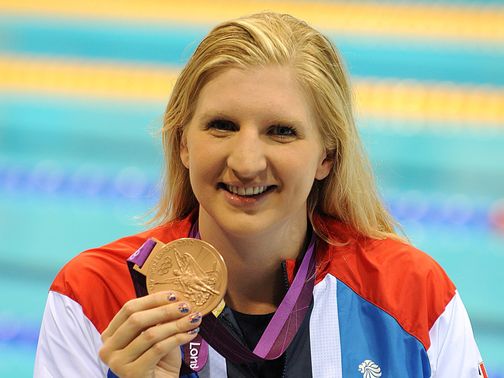
Black - A great performance from Becky Adlington to win bronze in her weaker event.  Expectations were high after her gold in the 400m four years ago, but this time was always likely to be a more difficult task.  Adlington's time for bronze, in a modern fabric swimsuit, was over 0.2 seconds faster than the time she swam for gold in Beijing - when she was in the now-outlawed hi-tech swimsuits which saw records fall at an unbelievable rate.


The only disappointment for me was Radio 5 Live's commentary.  With the girls on the final length of the race, commentator Bob Ballard gave up his main responsibility entirely, declaring 'We don't care' about the battle between France's Camille Muffat and America's Alison Schmitt for their event's highest honour, because he only wanted to talk about Adlington finishing third.  An understandable lapse of any pretence of neutrality, but a bad one, and disrespectful not just to the swimmers fighting for gold, but to any French or American listeners.  We had to wait almost twenty seconds after the race finished before Ballard bothered to mention who had won.

The BBC's coverage of the games has excellent depth to the main and most televisual events, but from what I've seen and heard so far, there's a lot of discussion about those select few at the expense of actual coverage of some of the lower-profile competitions.

Red -  It turns out Spain's footballers aren't completely invincible.  They may have won three major titles in a row, but the Spanish Olympic football journey is over after just two games - slipping to defeats against Japan and, tonight, Honduras!  Joder.

Gold - After having removed baseball and softball from the Olympic programme for these games, the IOC replaced them on the list of their sports with rugby sevens and golf.  Sadly, rather than get them in for this Olympics, in the country which invented both games, they did not introduce the new arrivals until the 2016 competition, which will take place in that hot-bed of rugby and golf, Brazil.  Not the best timing.

Green - If you think I'm an Olympic addict, check out the curious case of Louisa Thomas from American sports site Grantland.  She confesses to a complete addiction.  I admit that however much I love the games, I have never asked for my ashes to be scattered at the IOC headquarters in Lausanne.